
Related on 4X4 Specialist
- ‘No Fault Found’ at the Dealer – What to Do When Your Range Rover Still Has a Problem
- All-Terrain Tyres on a Range Rover – What You Gain & What You Give Up
- Read: Best Tyres for a Range Rover – Michelin vs Pirelli vs Continental Compared
→ Range Rover & Land Rover diagnostics · Browse our full Land Rover & Range Rover knowledge base
Range Rover Warning Lights That Keep Coming Back: Electrical Fault Explained
You cleared the dash, drove away, and the same warning lamp reappeared within minutes. That sinking feeling is common when a Range Rover warning lights keep coming back. Multiple unrelated lights often trace to one electrical root cause: low voltage, a bad earth, or an intermittent sensor. Read on for a short answer, the components to suspect on L322 and L405 models, quick owner checks, and the right diagnostic steps to stop repeat visits.
Short answer: Clearing codes is not a fix
Clearing a fault code wipes the active warning from the dash but not the underlying condition; your vehicle’s modules run self-tests every drive cycle and will re-trigger the same code if a sensor, earth, or voltage fault persists, which is why range rover warning lights keep coming back.
On L322 and L405 Range Rovers the ECU, ABS, EAS and gateway modules re-check inputs during ignition cycles; a transient low-voltage event or corroded earth point will look like a repeating fault until the hardware is repaired.
Practical check
If a lamp returns within a single drive cycle, note conditions: cold start, highway speed, or after hard steering. Record which lights reappear; ABS, EPB, EAS and engine management together suggest an electrical or ground issue rather than eight different component failures.

Why low battery voltage causes recurring lights
Range Rovers are sensitive to voltage swings; even a weak battery or poor charging can trigger unrelated amber and red warnings because modules interpret erratic voltages as sensor faults, which explains why range rover warning lights returning often follow a failing battery or a jump-start event.
If battery voltage sags during cranking or under load the engine management, ABS, EAS and transmission modules can log faults; check resting voltage and charging voltage with a multimeter and bring module voltages to nominal before further testing.
Owner check
Measure battery voltage at the battery terminals with the engine off and again at idle; if you see large swings or no stable charging voltage, fit a known-good battery and retest the drive cycle before ordering parts.
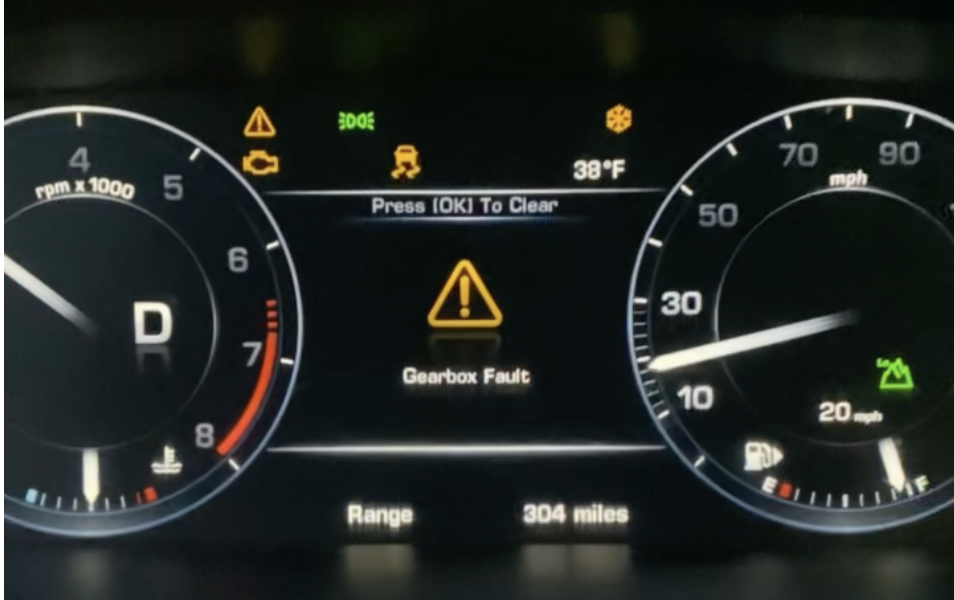

Clearing a fault code is only a temporary measure; a proper diagnosis finds and repairs the failing sensor, earth or battery that causes the range rover warning lights keep coming back.
Earths and grounds: the common hidden culprit
Corroded or loose earth points, particularly the chassis earth near the ABS pump and the engine block earth on L322 and L405 models, create intermittent signals that light ABS, gearbox, EPB and stability control warnings; a simple corroded M6 or M8 earth bolt can mimic multiple failing components.
Inspect and clean earth straps, torque bolts to factory spec, and re-test; many recurring electrical faults disappear when earths are restored to low-resistance contact.
Workshop action
Remove, inspect, and measure earth strap resistance with a DVM; where worn replace with OEM-quality straps and torque bolts to the correct spec to avoid future recurrence.
Failing sensors that produce intermittent or recurring warnings
NOx, oxygen (lambda), MAF and wheel speed sensors often give erratic readings before finally failing; the ECU and ABS module flag those transient errors and since the fault is real they will return even after a code clear, so a single sensor fault can explain why a range rover keeps showing fault lights on multiple systems.
Wheel-speed sensors on front hubs, for example, can pick up contamination or wiring chafing; a live-data trace on Pathfinder/SDD or a JLR-level scanner shows signal dropout, slope, and plausibility – the proof you need before swapping parts.
Owner inspection
Visually check sensor wiring looms for chafing, smeared grease, or broken clips; replacing a visibly damaged ABS sensor loom is straightforward but confirm with live data to avoid throwing parts at a recurring fault.


Before swapping modules, check battery health, charging voltage and all major earths near ABS and engine mounts; these are common, quick wins.
Why battery replacement or module resets can create new warnings
Replacing a battery or disconnecting modules forces control units to re-establish communications; during that relearn process you may see multiple unrelated warnings appear as modules exchange data and re-populate adaptive values, which can be mistaken for new faults.
After a battery change perform a full system scan and clear historic codes only after repairs; some modules require specific relearn procedures that generic scanners cannot perform.
Workshop checklist after battery work
Use a JLR-capable tool to run full module health checks and complete any relearn procedures; this prevents false recurring warnings caused by incomplete resets.

How interconnected systems create multiple lights from one fault
Range Rover modules share information over the vehicle network; a failing engine management sensor can upset ABS or traction control logic and simultaneously throw engine, traction and stability lamps, which explains why range rover dash lights wont clear cleanly after a simple reset.
Treat clustered warnings as a single diagnostic job: read the full fault history across modules, capture freeze-frame data, then run live-data while reproducing the symptom to find the originating signal rather than chasing the symptomatic module.
Example symptom chain
A weak MAF reading can richen mixture, trigger engine management light, change torque delivery and then cause the gearbox or stability control to log a fault; fixing only the gearbox will not stop the original MAF-driven cascade.


Pathfinder/SDD or equivalent tools are required to read full fault histories, freeze-frame data and to perform proper module relearns.
Proper diagnostic process to stop recurring Range Rover lights
Short answer: read full fault history, collect freeze-frame, reproduce with live-data and then repair; use Pathfinder/SDD or equivalent JLR-level diagnostic tools to access module histories and adaptives so you fix the cause, not just the code for why range rover warning lights keep coming back.
A methodical session includes battery and charging health, earth point resistance checks, scope or live-data traces on suspect sensors, and targeted component tests rather than blanket part replacements; record results and perform a drive-cycle test to confirm the warning remains cleared.
Step sequence
1) Full multi-module scan and save history. 2) Capture freeze-frame. 3) Check battery/charging and earths. 4) Live-data reproduce. 5) Repair and retest over complete drive cycle.


When to stop DIY and call a specialist
If warnings are red for brakes, steering or charging stop driving and book a professional diagnostic; intermittent faults that need live-data reproductions, freeze-frame analysis, or module software checks are best handled with JLR-level tools and wiring expertise.
If you have already had multiple garages clear codes without a permanent fix, bring the vehicle with any history or previous repair notes so the technician avoids repeating unsuccessful work and targets the root cause efficiently.
Book a proper diagnosis
If you need specialist auto-electrics work we can run a full JLR-level diagnosis, live-data capture and module updates; to book, see the service details in our workshop, bring any previous repair paperwork, and aim to present the car when the fault is currently showing.
Quick cause-symptom-action reference
| Cause | Typical dashboard lights | Owner action |
|---|---|---|
| Low battery / charging fault | Multiple amber/red across ECU, ABS, EAS | Measure battery and charging voltage; test with known-good battery |
| Corroded earth point | ABS, EPB, gearbox and stability control warnings | Inspect/clean earths near ABS pump and engine block; measure resistance |
| Intermittent sensor (NOx, MAF, wheel speed) | Engine management, traction, DPF or ABS lights | Inspect loom, test sensor signals with live data before replacing |
| Software/module glitch | Persistent or odd intermittent warnings after repairs | Check module software versions and apply JLR updates if available |
Frequently Asked Questions
Why does my Range Rover warning light keep coming back after being cleared?
How long does it take for a Range Rover warning to come back if the fault isn’t fixed?
Is it dangerous to keep driving with a recurring warning light?
Why won’t my dealer or local garage’s reset stick?
What are the most common recurring warning lights on a Range Rover?
Can a software update fix a recurring Range Rover warning?
How do you stop a Range Rover warning light coming back permanently?
How do I book a proper diagnosis at 4X4 Specialist?
Final Thoughts
Persistent dash lights are frustrating, but they rarely mean eight separate failures. Treat clustered or recurring warnings as an electrical or sensor problem; start with battery, charging and earths, then use a JLR-level diagnostic sequence to find and fix the root cause. That approach stops the loop of clear-and-return and saves time and money in the long run.
Book a proper diagnostic
If your Range Rover warning lights keep coming back, book a full JLR-level diagnosis with live data, freeze-frame capture and module software checks to find the real cause.
Sources
- General Land Rover technical references and common workshop practice – Background reading on Range Rover warning light behaviours and common causes.