
Related on 4X4 Specialist
- ‘No Fault Found’ at the Dealer – What to Do When Your Range Rover Still Has a Problem
- All-Terrain Tyres on a Range Rover – What You Gain & What You Give Up
- Read: Best Tyres for a Range Rover – Michelin vs Pirelli vs Continental Compared
→ Range Rover & Land Rover diagnostics · Browse our full Land Rover & Range Rover knowledge base

Why Range Rover Brakes Wear So Quickly: Weight, Regen, Towing and What to Do
You bought a Range Rover for comfort and capability, not to replace brake pads every other year. Yet many owners ask why range rover brakes wear quickly. The short answer: a heavy luxury SUV, modern wheel sizes and how you use the car combine to make braking a high-stress job. Read on for clear checks, model-specific points and treatments that actually extend pad and disc life.
Weight and physics: the unavoidable baseline
Short answer: mass equals wear. A Range Rover L405 or L460 typically weighs 2,400 to 2,800 kg empty; every stop must dissipate that kinetic energy through pads and discs. That is why range rover brakes wear quickly compared with a 1,500 kg saloon.
Detailed check you can do: weigh the impact of mass in real terms. If your L322 or L405 carries regular passengers and luggage the braking load increases; check pads visually and expect front pads to show more wear because high centre of gravity transfers weight forward under deceleration.
Practical inspection tip
If pads measure under 4 mm on a 2014 L405 or L494, factor in vehicle weight and arrange replacement; we usually recommend a full pad-and-disc check from 30,000 miles on heavily used models.

Towing and heavy load wear
Towing multiplies the problem. Pulling a 2,500 kg caravan or horsebox nearly doubles the kinetic energy each stop must absorb; we routinely see towing customers replacing pads at 15,000 to 20,000 miles versus 30,000+ for non-towing owners.
Practical upgrades: fit a semi-metallic towing pad from Brembo or Pagid and increase brake fluid servicing to annually; for long downhill runs use engine braking and avoid continuous light braking which quickly overheats pads and warps rotors.
When discs warp on descents
If you feel vibration under braking after a long descent, check rotor runout and thickness; on discovery or defender models with loaded towing duties we replace rather than machine rotors more often to avoid repeated warping.
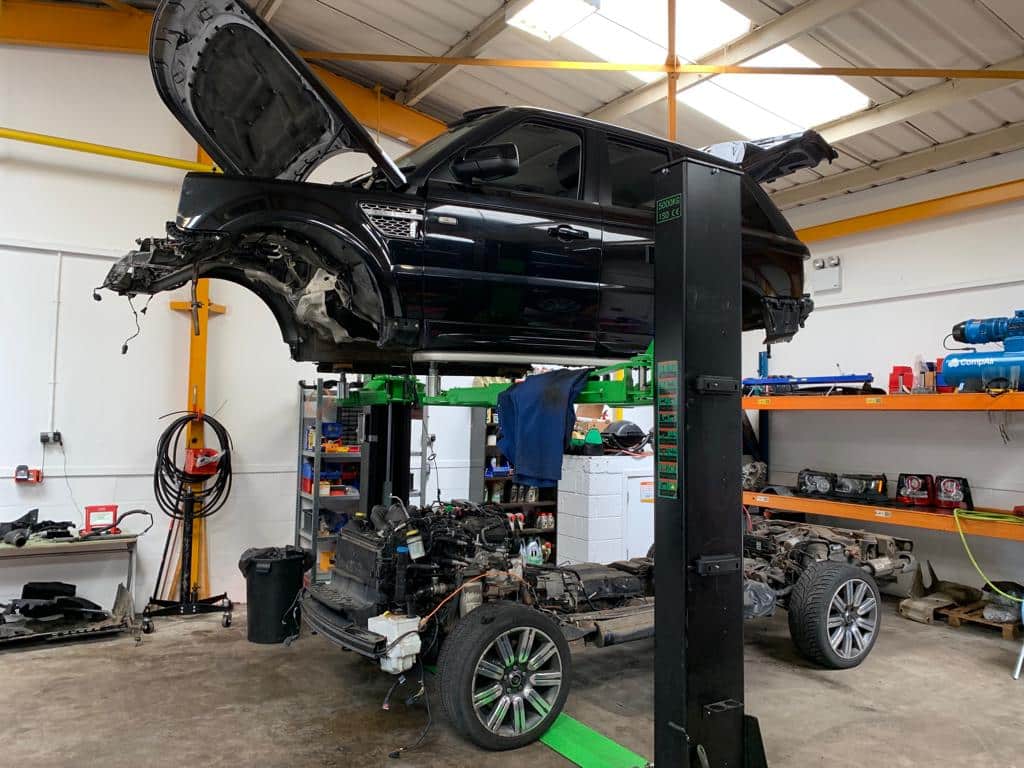

A Range Rover’s 2,400–2,800 kg mass increases braking energy every stop; expect faster pad consumption compared with smaller cars.
Regenerative braking in PHEV and MHEV models
Regen helps pad life but harms discs. PHEV models such as P400e, P440e and P510e use regenerative braking so friction pads rarely scrub the rotor surface; pads can last far longer, yet rotors oxidise and corrode from lack of contact.
Practical fix: every couple of weeks do a deliberate firm braking application from 50 mph in a safe location to ‘scrub’ the discs. We regularly see PHEVs with pads at 50% thickness but rotors so corroded they must be replaced.
Checks for PHEV/MHEV owners
Look for orange rust in the swept band and reduced braking bite after standing; if corrosion is heavy the swept band may pit despite thick pads and the rotor will need replacement.


Calipers, slide pins and EPB complications
Seized caliper slide pins are a hidden accelerant. Corroded pins or sticky pistons allow pads to stay in contact with the rotor, creating constant drag and rapid wear; this is common on older L322 and newer L405 cars where road salt has attacked components.
On modern models with Electronic Parking Brake you need the correct EPB tool and diagnostic reset to retract pistons safely. Never force EPB calipers open; improper handling can damage pads and motor units.
DIY checklist
Jack the car, remove the wheel and check caliper mobility; clean and lubricate slide pins with high-temp silicone or copper-free caliper grease and measure pad retraction after releasing the parking brake using the vehicle’s on-screen EPB release.

PHEV/MHEV regen very often saves pad life yet causes disc corrosion; perform a firm scrub stop every couple of weeks.
Rotor damage: grooves, pitting and oxidation
Grooves and pitting accelerate pad wear and can lead to cracks. When the rotor surface is uneven the pad wears to match that profile, losing life quickly and sometimes producing hot spots that cause cracking under repeated heavy use.
Measurement matters: always compare measured thickness to the minimum stamped on the rotor and use a dial micrometer for runout; if a rotor shows deep pitting or is below the stamped min then replacement is far cheaper than repeat machining and failure.
Rotor servicing advice
For heavy-use SUVs we typically replace rotors rather than resurface when corrosion or heat checks exceed safe limits; for PHEV rotors with heavy edge corrosion replacement preserves braking performance and avoids uneven pad wear.

Wheels, tyres and driver habits that speed wear
Large wheels raise rotational inertia. Optional 22 and 23 inch wheels on L405, L460 and L494 increase braking effort because the heavier rims and larger tyres require more energy to slow; even if brakes are upsized, wear per mile rises.
Driver habits matter: resting your foot on the brake pedal, repeated late heavy stops or ‘feathering’ down long descents cooks pads. Use progressive braking, allow engine braking where possible and avoid light continuous braking after 500 kg of extra load.
Quick habit checks
Try timing your stops: consistent hard stops from 70 mph to 0 cause far more wear than progressive stopping from 30 mph. Rotate tyres and check pressures regularly to avoid extra drag that feeds into brake wear.

If you tow regularly, fit semi-metallic towing pads and increase brake-fluid servicing to yearly to avoid overheating and warped rotors.
Pad compounds and upgrade options
Match compound to use. For everyday roadwork fit an OE-equivalent ceramic-organic pad from Pagid, Textar or Mintex Red Box for long life, low dust and quietness. Expect typical life around 30,000 to 40,000 miles on city/highway mix.
If you tow frequently or habitually carry heavy loads choose semi-metallic pads such as Brembo or EBC Yellowstuff; they handle heat better and last longer under strain but produce more dust and can be noisier. For track use a full metallic pad is right, but not recommended for daily road use.
Compound selection tip
Tell your service technician whether you tow, carry heavy loads or use the car for short urban runs; we recommend semi-metallic for towing and Pagid OE-equivalents for mixed use, and we fit pads to match each model’s caliper and rotor geometry.

Maintenance checklist and when to call a specialist
Routine checks that extend life: visual pad thickness under 4 mm, rotor runout and thickness against stamped minimum, DOT 4 brake fluid change every 12 to 24 months and caliper pin lubrication. Measure moisture content in the fluid with a tester and replace if over 3 percent.
If you prefer professional help we offer tailored brake inspections, pad and disc replacement and EPB calibration; see our brake servicing page for full details and model-specific options. For heavy-towing vehicles we will recommend compound, hydraulic checks and a brake-fluid schedule.
When to call us
Call for pulsation under braking, orange rust in the swept band on PHEVs, seized calipers or pad wear below 4 mm. EPB caliper jobs need the right tool and a diagnostic reset to avoid faults and P0000-style parking brake warning lights.

Pad Compound Comparison for Range Rovers
| Use case | Compound | Typical pad life (miles) |
|---|---|---|
| Everyday road (city/highway) | OE-equivalent ceramic-organic (Pagid, Textar, Mintex Red Box) | 30,000 to 40,000+ |
| Towing / heavy load | Semi-metallic (Brembo, EBC Yellowstuff, Pagid towing pads) | 15,000 to 25,000 |
| Performance / track | Full metallic | 5,000 to 15,000 |
Frequently Asked Questions
Why do Range Rover brakes wear faster than other cars?
Does regenerative braking on PHEV and MHEV Range Rovers help or hurt brake life?
How much faster do brakes wear if I tow with my Range Rover?
What pad and disc options give the best Range Rover brake life?
Where do I book a brake inspection at 4X4 Specialist?
Final Thoughts
Range rover brakes wear quickly because of a mix of mass, how you use the vehicle and modern systems that change wear patterns. With the right pad compound, routine checks and brief maintenance habits you can stretch service intervals and avoid unnecessary rotor replacement. Tackle the problem proactively and your Range Rover will stop as it should.
Book a brake check
If your Range Rover is eating pads, book a focused brake inspection. We measure discs, test fluid moisture, check calipers and recommend the right pads for towing or daily use.
Sources
- YourMechanic: Brake pads wearing out quickly inspection – Brake inspection checklist and common causes
- Birmingham Land Rover blog on prolonging brake life – Tips for Defender and Discovery brake care
- LandRoverWorld forum discussion on rear pads wearing faster – Owner experiences with brake bias and wear patterns
- Autoblog report on Range Rover brake concerns – News item on early brake-wear complaints