
Related on 4X4 Specialist
- How Often Should You Replace a Range Rover Battery & What Type Do You Need?
- Discovery Sport MHEV Fault – 48V Battery Issues & What It Costs to Fix
- How Long Does a Range Rover P400e Battery Last & What Does Replacement Cost?
→ Range Rover battery replacement & coding · Browse our full Land Rover & Range Rover knowledge base

Range Rover ‘Low Battery – Start Engine’ Warning: What’s Actually Going On
You open the door, the dash lights up and the message ‘Low Battery – Start Engine’ stares back at you. On Evoque L538, Velar L560, Sport L494 or full-size L405 models this is the BMS telling you the 12V pack is below a safe level and it wants the engine started now. Read on for a fast explanation, simple checks you can do with a multimeter, and the practical next steps.
Short answer: what the message means
Short answer: the Battery Management System has detected the 12V battery voltage has fallen below the safe threshold and is asking you to start the engine so the alternator or BSG can recharge it; this happens on Range Rover L405, L460, Sport L494, Velar L560, Evoque L538 and Discovery models.
Practical effect: the car will begin load shedding, switching off non-essential systems such as heated seats, infotainment and reducing HVAC fan speed to protect remaining charge; if you do nothing you risk a no-start next time, especially on vehicles with AGM batteries aged over 3 to 4 years.

How the BMS works and why it flags low voltage
The BMS constantly monitors 12V state of charge and voltage on every Range Rover platform; if it sees voltage fall below the programmed safety threshold it triggers the ‘range rover low battery start engine warning’ so the alternator or the 48V/DC-DC system can top the pack up.
On MHEV vehicles with a 48V Belt Starter Generator the DC-DC converter is also involved; a fault in the BSG or DC-DC can leave the 12V battery discharged on L551 Evoque or L551 Velar variants, so the BMS may still show the message even after a drive.
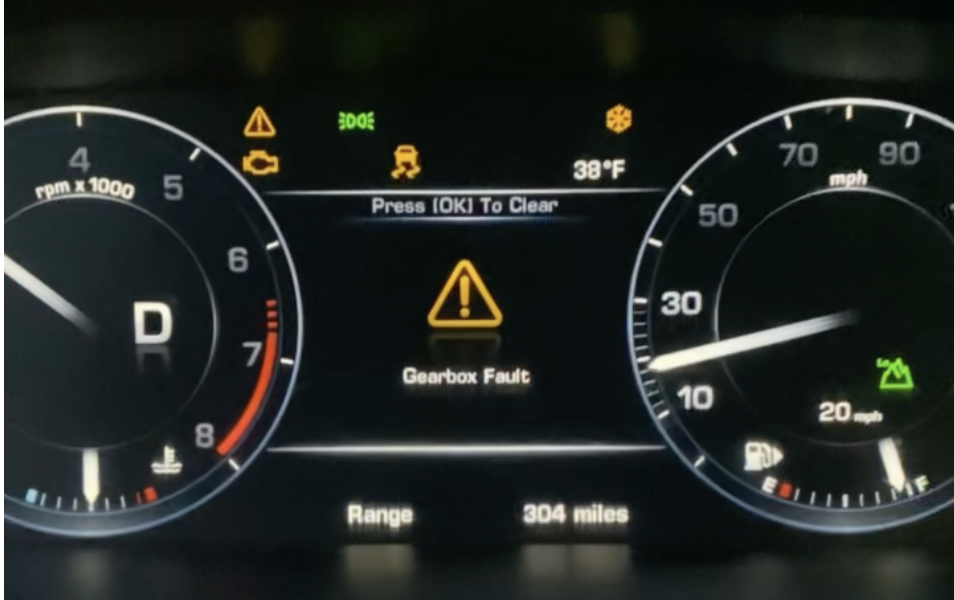

Start the engine and drive for 30+ minutes at moderate speed to let the alternator or BSG recharge the 12V pack on L405, L494 and L560 models.
Symptoms you will notice
Typical symptoms: the warning itself plus dimming dash lights, slow cranking or long starter motor spin on L494 Range Rover Sport and L405 Vogue, progressive shutdown of infotainment and seat heating, and sometimes the vehicle will refuse to lock or unlock if the 12V falls too low.
What you might see during a start: if resting voltage is under about 12.2 volts on a digital multimeter and cranking causes voltage to collapse below roughly 9.5 volts, the battery will likely fail a load test and need replacement; note exact thresholds vary by model year and BMS calibration.
Load-shedding sequence
Sequence: infotainment and non-essential 12V circuits drop first, then heated seats and interior lights, followed by reduced HVAC blower speed on models like Discovery 5 and Defender L663; this preserves enough charge to start the engine if you act promptly.
If you leave the vehicle without starting, you will progressively lose convenience functions and eventually encounter a crank/no-start scenario, especially if the battery is an AGM over 4 years old or the alternator is weak.

Most frequent causes: ageing AGM, short trips and parasitic drains
Ageing AGM battery: modern Range Rovers use AGM technology which gives better cycle life under stop-start use but tends to lose usable capacity by year three or four on L538 Evoque and L560 Velar; replace proactively around 3 to 4 years if capacity tests low.
Short trips and usage: repeated sub-5 mile urban runs on petrol V6 or diesel 3.0 TD4 engines prevent the alternator from restoring charge fully, so after dozens of starts the BMS sees a low state-of-charge and shows the ‘range rover low battery warning’.
Parasitic drain and aftermarket kit: a dashcam or tracker wired to a permanent live, or a module failing to enter sleep (infotainment, telematics) can draw 0.05 A to 0.5 A overnight; that cumulative drain will trigger the BMS on models from L320 up to L663.

If the warning returns, get a load test and parasitic draw scan; a failed AGM usually needs OE replacement and BMS coding.
Quick checks you can do yourself before calling a garage
Step 1, resting voltage: with the vehicle untouched for 12 hours measure the 12V battery across the positive and negative terminals with a digital multimeter; a healthy AGM shows about 12.6 V, anything under 12.2 V is a sign of low charge on most Range Rover models including L405 and L494.
Step 2, charge by driving: if safe, start the engine and take a sustained 30 minute run at motorway or A-road speeds; a healthy alternator on a 3.0 diesel or 2.0 petrol should recover the battery state-of-charge and clear the warning on return.
Step 3, when to load test or scan: if the warning returns the next morning or after a 30+ minute drive, arrange a battery load test and parasitic draw scan; a failing AGM usually shows permanent capacity loss on a load tester and will need OE-spec replacement and BMS coding.
What to watch on the dash
If the message persists and you see fault codes like U1000 or BMS-related entries on the dash, use an OBD2 scanner that reads JLR modules to capture live voltage and BMS state-of-charge on L560 Velar or L551 Evoque.


When it is more than the battery: alternator, BSG and parasitic faults
Alternator faults: a failed diode or worn regulator will stop the alternator charging on the move; expect to see battery voltage fall while driving and the low battery warning persist on L405, L551 and Defender L663 models, replace alternator units often after 80,000 to 120,000 miles depending on use.
MHEV interactions: on mild-hybrid Range Rovers the 48V BSG and DC-DC converter must convert energy down to 12V; faults here can bleed the 12V battery at rest or fail to replenish it while driving, a specialist scan of the BSG and DC-DC data is required to isolate this on L551 and L560 models.
Parasitic draw hunts: a parasitic draw test that isolates fuses one circuit at a time will reveal modules drawing excessive current; expect diagnostic labour time of 1 to 3 hours depending on complexity and model L405 to L494.

Fit a smart maintenance charger for cars that sit, avoid long periods with ignition on and replace AGM batteries proactively around 3 to 4 years.
Replacement, coding and costs
Battery replacement: fit an OE-spec AGM battery and perform a BMS reset and coding with a JLR-capable OBD2 tool; typical parts for an L405/L494 style AGM cost around £220 to £420 plus labour of 0.5 to 1.5 hours for removal and coding depending on model.
What the garage must do: after fitting the new pack the BMS must be initialised and the vehicle coded so the BMS learns the new battery chemistry and capacity; failure to code can lead to false low-battery messages on next morning starts, particularly on L538 Evoque and L560 Velar.
If you prefer a specialist to handle everything we offer a full Range Rover battery replacement service including OEM AGM supply and BMS coding; book a diagnosis or replacement via our service page Range Rover battery replacement.
Common causes, quick checks and typical costs
| Cause | Quick owner check | Typical fix & cost |
|---|---|---|
| Ageing AGM (3-4 years) | Resting voltage <12.2 V; repeated warnings after a drive | OE AGM battery £220-£420 plus 0.5-1.5 hrs labour and BMS coding |
| Short journeys | Battery recovers after 30+ minute run | No parts; change driving habit or fit smart charger £30-£120 |
| Parasitic drain | Fuses isolate circuit drop in draw test | Diagnostic 1-3 hrs; repair wiring or remove accessory |
| Alternator/BSG fault | Voltage falls while driving; persistent warning | Alternator/BSG diagnosis; part replacement from £180 depending on model |
Frequently Asked Questions
What does ‘Low Battery – Start Engine’ mean on a Range Rover?
Is it safe to drive when the low battery warning is on?
How much does it cost to fix a low battery warning?
What are the most common causes of repeated low battery warnings?
How can I prevent the low battery warning from returning?
Final Thoughts
The ‘Low Battery – Start Engine’ message is a protective alert; act quickly and most Range Rover owners will clear it with a 30+ minute drive. If the warning comes back, get a load test and parasitic scan; replacing an OE-spec AGM and coding the BMS is a routine specialist job that prevents repeats.
Need help diagnosing a Range Rover low battery warning?
Book a battery diagnosis or a full Range Rover AGM replacement with BMS coding. We cover all models including L405, L494, L560, L538 and Defender L663. Battery and charging-system tests are free; most diagnoses are completed within an hour.
Sources
- YouTube walkthroughs and owner threads – Video examples of the warning and owner troubleshooting
- TechRoute66 battery write-up – Practical owner guidance on Evoque low battery messages
- Owner forum reports – Forum discussions detailing symptoms and fixes